Too Much Snow on the Roof? When Ottawa Homeowners Should Consider Roof Snow Removal
Heavy snowfall is a normal part of winter in Ottawa, but that does not mean every roof needs to be cleared after a major storm.
The amount of snow on a roof is only one part of the equation. Snow density, drifting, roof design, structural capacity, previous snowfall, and whether the snow has become wet or compacted can all affect the load on a roof.
For homeowners, the more useful question is not simply, “How many inches of snow are on my roof?”
It is:
Is the roof accumulating an unusually heavy or uneven load, and are there signs that the roof or structure may be under stress?
This guide explains what Ottawa homeowners should know about roof snow loads, ice dams, warning signs, DIY snow removal, and when professional help may be appropriate.
Key Takeaways
| Question | Practical answer |
|---|---|
| Is there a universal snow-depth limit for every roof? | No. Snow depth alone does not determine whether a roof is overloaded. |
| Is wet snow more concerning than light powder? | Generally, yes. Wet and compacted snow can be substantially heavier than fresh, dry snow. |
| Does every roof need snow removal after a big storm? | No. Many roofs are designed to carry normal winter snow loads. |
| What should homeowners watch for? | Sagging, new cracks, unusual noises, sticking doors or windows, and other signs of structural movement. |
| Are ice dams the same as structural snow loads? | No. Ice dams are primarily related to roof temperature, heat loss, air leakage, insulation, and ventilation. |
| Should homeowners climb onto a snowy roof? | Generally, no. A snowy or icy roof creates a significant fall hazard. |
| When should a professional be considered? | When there is unusually heavy or uneven accumulation, difficult roof access, an ice-dam problem, or concern about possible structural distress. |
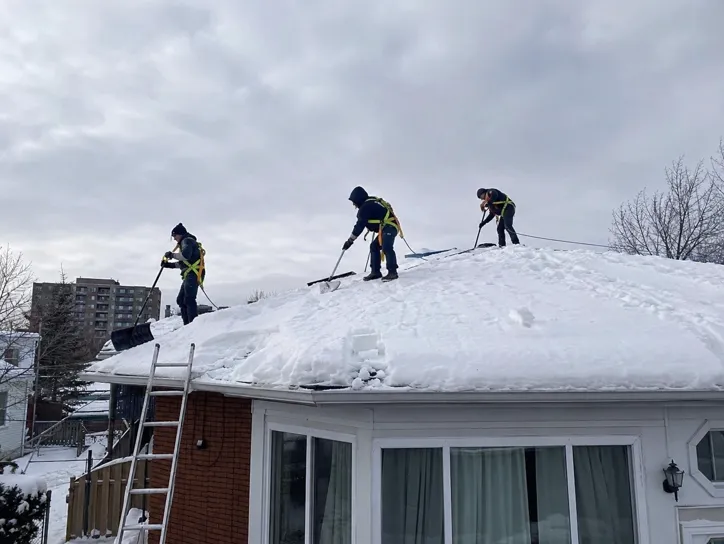
How Much Snow Is Too Much for a Roof?
There is no single snow-depth number that homeowners can apply to every house.
A roof’s ability to handle snow depends on factors such as its structural design, span, slope, materials, age, condition, and the loads it was designed to withstand.
The weight of the snow also matters.
Fresh, dry snow can be relatively light, while wet snow is much denser. Snow that has partially melted and refrozen or become compacted can also weigh considerably more than its original fluffy depth suggests.
Wind can create another problem: drifting.
Snow does not always distribute itself evenly across a roof. Wind can move snow from one section to another, producing deeper accumulations in valleys, behind roof features, or against higher sections of the building.
That means two roofs with the same measured snow depth can experience very different loads.
Why Snow Depth Alone Can Be Misleading
Imagine two roofs that each have 30 centimetres of snow.
On one roof, the snow is light and dry and evenly distributed.
On the other, the snow is wet, compacted, and heavily drifted on one side.
The second roof may be carrying a much greater load even though the measured depth is identical.
This is why a simple rule such as “remove snow whenever it reaches X inches” can be misleading without considering the type and distribution of the snow and the characteristics of the roof.
For concerns about the structural capacity of a specific building, homeowners should rely on the building’s design information or advice from a qualified building professional rather than an arbitrary internet snow-depth threshold.
Which Roofs Can Be More Challenging During Heavy Snow?
Some roof configurations are more prone to accumulating snow unevenly.
Examples include:
- Roofs with multiple slopes or levels
- Roof valleys
- Areas behind higher roof sections
- Sections surrounded by parapets or other obstructions
- Roofs with additions or interconnected structures
- Areas where wind repeatedly deposits snow
- Low-slope roofs where snow can remain for extended periods
The issue is not that these roof types are inherently unsafe.
Rather, their geometry can affect how snow accumulates and where loads are concentrated.
Signs That a Roof May Be Under Structural Stress
Homeowners should pay attention to changes inside and outside the building after a major snowfall.
Possible warning signs include:
- A visible sag or change in the roofline
- New cracks in ceilings or interior walls
- Doors or windows that suddenly become difficult to open or close
- Unusual creaking, popping, or cracking sounds
- Roof members that appear to be bending or moving
- Water entering the building where it was not leaking previously
- A noticeable change in the shape of the roof or ceiling
These signs do not automatically mean that a roof is about to fail. Buildings can move for many reasons.
However, a combination of unusual structural changes and heavy snow accumulation warrants attention.
If you believe a structure is in immediate danger, keep people away from the affected area and contact an appropriate qualified professional or emergency service.
Snow Load and Ice Dams Are Different Problems
Snow accumulation and ice dams are often discussed together, but they are not the same thing.
Snow Load
Snow load concerns the weight of accumulated snow and ice on the structure.
The important variables include:
- Snow density
- Total accumulation
- Compaction
- Drifting
- Distribution across the roof
- Roof geometry
- Structural design and capacity
Ice Dams
An ice dam is a ridge of ice that forms near a roof edge and can interfere with the drainage of melting snow.
Ice dams are generally associated with heat escaping from the building into the roof space, uneven roof temperatures, inadequate insulation or air sealing, and ventilation conditions.
This distinction matters because removing snow is not necessarily a permanent solution to an ice-dam problem.
If the underlying heat-loss problem remains, ice dams can return.
What Causes Ice Dams?
A simplified version of the process looks like this:
- Heat escapes from the heated part of the house into the roof space.
- Sections of the roof become warmer than others.
- Snow on those warmer sections begins to melt.
- Meltwater flows toward colder roof edges.
- The water freezes near the colder eaves.
- Repeated melting and freezing can create a larger ice buildup.
Once an ice dam forms, additional meltwater can have difficulty reaching the gutters and downspouts.
The result can include water intrusion around roof edges, ceilings, walls, or insulation.
Gutters Are Not Usually the Root Cause
A common explanation is that ice dams are caused by clogged gutters.
Gutters can certainly be blocked by ice or snow, and drainage problems can make winter water management worse.
But a classic ice-dam problem is primarily related to uneven roof temperatures and heat transfer, not simply a dirty gutter.
For a recurring ice-dam problem, improving insulation, air sealing, and ventilation may be more important than repeatedly removing the ice itself.
What Homeowners Can Check From the Ground
After a major snowfall, homeowners can inspect their property without climbing onto the roof.
Look for:
- Large differences in snow depth across roof sections
- Heavy drifts around valleys or roof transitions
- A visibly sagging roofline
- Snow sliding or falling from roof edges
- Large icicles or visible ice buildup
- Water stains or active leaks inside the house
- New cracks or changes around ceilings and walls
- Unusual sounds coming from the structure
Do not stand underneath areas where large amounts of snow or ice could fall.
A roof can look stable from the ground while still presenting a fall hazard or structural concern, so avoid climbing onto it simply to measure the snow.
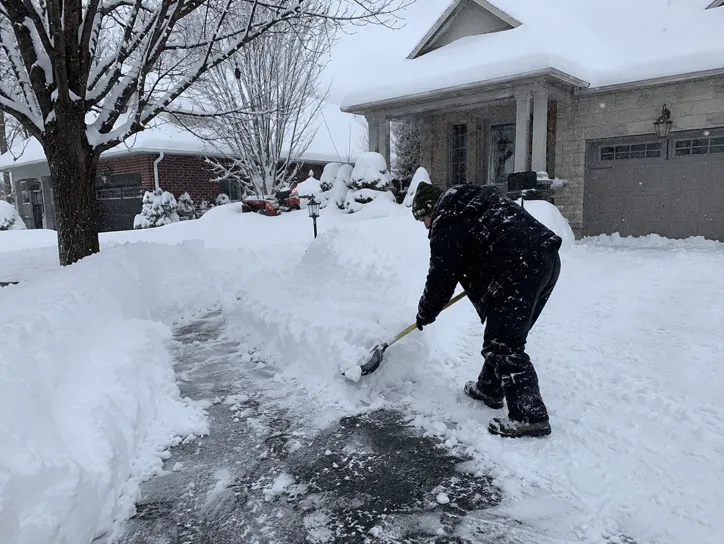
Should You Remove Roof Snow Yourself?
For most homeowners, getting onto a snowy roof is not a sensible DIY task.
Snow, ice, and sloped roofing create obvious fall hazards. Adding a ladder, cold temperatures, limited visibility, and potentially brittle roofing materials increases the risk.
If a homeowner decides to remove a small amount of accessible snow from ground level, the equipment and technique matter.
A roof rake designed for ground-level snow removal can sometimes be used from a safe position.
However, aggressive scraping is not appropriate.
The goal is not necessarily to expose every square inch of roofing. Trying to remove every last layer of snow can increase the chance of damaging shingles, flashing, membranes, gutters, or other roof components.
Can Removing Snow Damage a Roof?
Yes.
Snow removal is not automatically harmless simply because snow itself is a problem.
Improper techniques can:
- Break or dislodge shingles
- Damage flashing
- Scratch or puncture roofing membranes
- Damage gutters or roof-edge components
- Pull at roofing materials
- Create falling ice hazards
- Damage vents or other rooftop equipment
Metal tools and aggressive scraping are particularly problematic on some roofing systems.
The appropriate approach depends on the roofing material and the situation.
When Should You Consider Professional Roof Snow Removal?
Professional assessment or removal may be appropriate when:
1. Snow accumulation is unusually heavy
A major storm followed by additional snowfall can produce a substantial cumulative load.
2. Snow is heavily drifted
Uneven accumulation can create localized loading that is difficult to evaluate from the ground.
3. The roof is difficult or dangerous to access
Steep slopes, multiple roof levels, ice, and other obstacles increase fall risk.
4. You see signs of possible structural distress
Sagging, new cracks, unusual noises, or other changes should not be ignored.
5. There is a serious ice-dam problem
Professional removal can address the immediate buildup, while a building-envelope assessment may be needed to address the underlying cause.
6. You are unsure whether removal is necessary
A qualified professional can evaluate the situation without requiring the homeowner to climb onto the roof.
What Professional Roof Snow Removal Involves
Professional roof snow removal is more than simply pushing snow off the roof.
A careful service should begin with an assessment of the roof and the surrounding conditions.
Depending on the building, the work may involve:
- Assessing snow accumulation and access conditions
- Identifying areas of concentrated snow
- Protecting roofing materials
- Using equipment appropriate for the roof system
- Removing snow in a controlled manner
- Managing where snow and ice are deposited
- Avoiding damage to vents, flashing, gutters, skylights, and other components
- Maintaining safe working practices around ladders, edges, and falling material
The exact method should be adapted to the building rather than treated as a one-size-fits-all procedure.
What About Ice-Dam Removal?
Ice dams can require a different approach from ordinary snow removal.
Removing visible ice may provide temporary relief, but it does not necessarily solve the reason the ice formed.
If ice dams repeatedly occur, the building should be evaluated for potential problems involving:
- Attic insulation
- Air leakage between the heated space and attic
- Roof ventilation
- Roof and attic design
- Heat escaping through penetrations or other building components
A contractor dealing with the immediate ice buildup and a professional assessing the underlying building-envelope problem may be addressing two different parts of the same issue.
What Does Roof Snow Removal Cost in Ottawa?
There is no reliable single price for roof snow removal.
The cost can vary depending on:
- Roof size
- Roof height
- Roof pitch
- Roof accessibility
- Amount and type of snow
- Ice accumulation
- Number of roof levels
- Whether specialized equipment is required
- Travel and site conditions
- Whether the work is routine or emergency service
A straightforward low-slope roof with easy access is a different job from a steep, multi-level roof covered in compacted snow and ice.
For that reason, homeowners should compare quotes based on the actual scope of work rather than choosing a service based solely on a headline price.
Ask what the quote includes, how the contractor plans to access the roof, how snow will be removed, and whether ice-dam work is included separately.
What to Do After a Major Ottawa Snowfall
A practical approach is:
Step 1: Inspect from the ground
Look for unusual accumulation, drifting, visible roof deformation, and falling-snow hazards.
Step 2: Check the interior
Look at ceilings, upper walls, and attic-access areas for new cracks, water stains, leaks, or other changes.
Step 3: Consider the type of snow
Fresh powder, wet snow, compacted snow, and ice do not have the same weight.
Step 4: Consider the roof design
Pay particular attention to valleys, multiple roof levels, and areas where snow tends to drift.
Step 5: Do not climb onto an icy roof just to inspect it
A visual inspection from a safe location is preferable to creating a fall hazard.
Step 6: Get professional advice when the situation is unclear
If the accumulation is unusually heavy, concentrated, or accompanied by signs of structural movement, professional assessment is appropriate.
Frequently Asked Questions
How much snow can a roof hold in Ottawa?
There is no universal number that applies to every Ottawa roof.
The answer depends on the building’s structural design, snow density, accumulation, distribution, roof geometry, and other factors.
Is 12 inches of snow dangerous on a roof?
Not necessarily.
Twelve inches of dry, low-density snow can represent a very different load from twelve inches of wet, compacted snow. Roof capacity also varies between buildings.
Is wet snow heavier than dry snow?
Yes. Water is much denser than snow, so wetter snow generally weighs more for the same measured depth.
Do I need to remove snow after every major storm?
No.
A properly designed roof is expected to withstand normal winter conditions. Snow removal becomes more relevant when accumulation is unusually heavy, uneven, repeated, or accompanied by warning signs.
Can snow cause a roof to collapse?
In extreme circumstances, excessive snow and ice loading can contribute to structural failure.
However, homeowners should not assume that a particular snow depth automatically means collapse is imminent. Structural capacity and actual loading conditions matter.
Do ice dams mean my roof is overloaded?
Not necessarily.
Ice dams are primarily a roof-temperature and building-envelope issue. They can cause water intrusion even when the roof structure is not experiencing an excessive snow load.
Can I use a shovel to remove roof snow?
Using a conventional shovel on a roof can damage roofing materials and creates a significant fall hazard.
If snow needs to be removed, use an appropriate ground-level method where practical or have the work performed by someone equipped and trained for the conditions.
Should I remove all the snow down to the shingles?
Not necessarily.
Aggressive removal can damage roofing materials. The appropriate technique depends on the roof system and the reason for removing the snow.
What should I do if I notice my ceiling sagging after a snowfall?
Treat a new or worsening sag as a potential structural warning sign.
Keep people away from the affected area and seek professional assessment. If there is an immediate danger of structural failure, contact emergency services.
The Bottom Line
Ottawa homeowners do not need to panic every time a major snowfall covers the roof.
They also should not rely on a single snow-depth number to decide whether a roof is safe.
The important factors are snow weight, accumulation, distribution, roof design, structural capacity, and visible signs of distress.
Ice dams are a separate issue, driven primarily by roof temperature and heat transfer. Removing an ice dam may address the immediate problem, but recurring ice dams can indicate an underlying insulation, air-sealing, or ventilation issue.
The safest approach is to inspect from the ground, avoid unnecessary roof access, watch for structural warning signs, and seek qualified professional help when accumulation or roof conditions create a genuine concern.
For Ottawa homeowners, the goal should not be to remove snow simply because it is there. The goal is to identify when snow or ice has created a problem that actually needs to be addressed.