Snow load & ice damsRoof-safe methodsFree written quotes
Roof snow removal in Ottawa
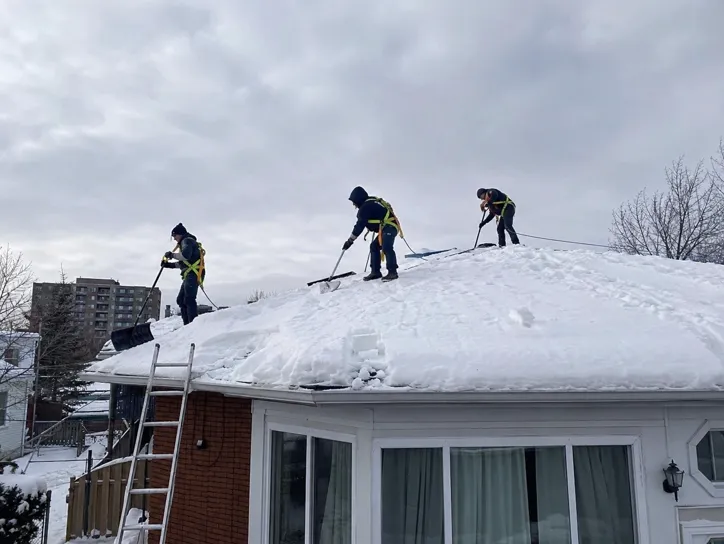
Snow Removals Ottawa handles roof snow removal and ice dam clearing for Ottawa homes and flat-roof buildings – because after a heavy-snow stretch, the most dangerous snow on the property is over your head. Roof-safe methods, not a shovel and luck.
Free written quotes
Insured local crew
24/7 storm monitoring
Serving all of Ottawa
Get your free snow removal quote
Tell us about the property and we will reply with a clear written price.
No obligation. We reply within one business day.
When to worry
The signs your roof needs relief
Sixty-plus centimetres of accumulated snow, visible sagging, doors that suddenly stick, icicles thicker than your arm, or water staining at ceiling edges – these are the roof telling you the load or the ice dam has gone too far. Flat and low-slope roofs, carports, and older additions are the usual victims.
Roof Snow Overload Warning Signs on Ottawa Homes and Buildings
A sagging roof line or a new dip
Sight along the ridge and the eave from the ground. A line that used to be straight and now shows a dip or a wave, or a soffit and fascia that suddenly look out of plane, is the most direct visible signal that a roof is carrying more than it is comfortable with.
Cracks, sticking doors and sticking windows
Fresh cracks in ceilings or interior walls that appear during a heavy-snow stretch, and doors or windows that suddenly bind in frames that worked fine in November, mean the structure is deflecting. Cosmetic cracking happens in every house; cracking that arrives with the snow and eases after a thaw is a different thing.
New popping and creaking under load
Buildings make noise, but a repeated pop or a groan that follows a heavy snowfall and returns on each cold night is worth taking seriously. Note when it happens and what the roof looked like that week, because the pattern tells you far more than any single sound does.
Ice at the eave is a symptom, not a cosmetic problem
Heat escaping through the attic melts snow on the upper roof, the meltwater runs down to the cold eave and refreezes into a ridge, and that ridge backs water up under the shingles and into the wall or ceiling. Thick icicles and a solid ice line at the gutter are the visible half of a problem doing its damage out of sight.
By-law No. 2005-208 puts this on the owner
The by-law requires property owners and occupants to keep roofs and the surrounding lands free of snow and ice hazards, and it sets no removal timeframe. The surrounding lands wording matters as much as the roof does, because what comes off a roof lands on the walkway, the entrance and the parking below, and clearing that is part of the same job.
Load is water, not depth
Why Roof Snow Load in Ottawa Is About Water Content, Not Snow Depth
Depth is the number everyone quotes and it is close to useless on its own. What a roof carries is the weight of the water held in the snow, and the same 30 cm can vary enormously depending on what that snow has been through. Fresh cold powder is mostly air. The same layer after a week of settling, a wind event and one warm afternoon is a fraction of the depth and a multiple of the weight. Add freezing rain and it takes on a solid crust. Add rain onto an existing pack and the pack absorbs it the way a sponge does, gaining mass over a few hours with no visible change in how deep it looks from the driveway. The Ontario Building Code reflects this: the specified roof snow load is calculated with a rain component on top of the ground snow load, and it can never be taken as less than one kilopascal no matter what the calculation returns. What we do here is bounded, and it is worth saying plainly. We assess visible conditions, reduce snow load, and clear what comes off the roof from the walkways and entrances underneath. We do not perform structural engineering assessments and we do not offer an opinion on what a given roof can carry. Anything beyond visible warning signs belongs with a licensed engineer, and if that is what we find, that is what we will tell you.
Snow Removals Ottawa takes the most dangerous part of an Ottawa winter off your roof: snow load reduction and ice dam removal, done with methods that protect the shingles underneath.
Snow load is a structural problem, not a chore
Wet snow weighs three times what powder does, and an Ottawa roof can be carrying tonnes of it by February. Add a freezing-rain crust and a thaw that sends meltwater against an ice dam, and you get the classic late-winter claims: sagging carports, leaking ceilings, collapsed additions. Roof clearing is cheap insurance against expensive damage – and it is emphatically not a job for a homeowner on an aluminum ladder in January. If the walkways below also need attention, our one-time clearing crew can handle both in a single visit.
Roof snow removal – FAQs
When should a roof be cleared in Ottawa?
As a rule of thumb: after 60 cm or more of accumulated snow, after freezing rain adds a heavy ice layer over deep snow, or as soon as you see sagging, sticking doors, or big ice dams. Flat and low-slope roofs need attention earlier than steep ones.
What is an ice dam and why does it matter?
An ice dam is a ridge of ice at the roof edge that traps meltwater behind it. That water backs up under shingles and shows up as ceiling stains and wall damage. Removing the dam lets the roof drain before the water finds your insulation.
Will removal damage my shingles?
Done properly, no. We deliberately leave a thin snow layer rather than scraping to the surface, because shingle granules do not survive steel edges in minus twenty. Chiselling ice off shingles is how a $500 job becomes a $10,000 roof repair.
Do you clear commercial flat roofs?
Yes – flat and low-slope commercial roofs, carports, and canopies. These carry the highest load risk and are quoted after a look at access and drainage.
Heavy winter overhead?
Send a photo – we will tell you honestly whether the roof needs it.
To provide the best experiences, we use technologies like cookies to store and/or access device information. Consenting to these technologies will allow us to process data such as browsing behaviour or unique IDs on this site. Not consenting or withdrawing consent, may adversely affect certain features and functions.
Functional
Always active
The technical storage or access is strictly necessary for the legitimate purpose of enabling the use of a specific service explicitly requested by the subscriber or user, or for the sole purpose of carrying out the transmission of a communication over an electronic communications network.
Preferences
The technical storage or access is necessary for the legitimate purpose of storing preferences that are not requested by the subscriber or user.
Statistics
The technical storage or access that is used exclusively for statistical purposes.The technical storage or access that is used exclusively for anonymous statistical purposes. Without a subpoena, voluntary compliance on the part of your Internet Service Provider, or additional records from a third party, information stored or retrieved for this purpose alone cannot usually be used to identify you.
Marketing
The technical storage or access is required to create user profiles to send advertising, or to track the user on a website or across several websites for similar marketing purposes.