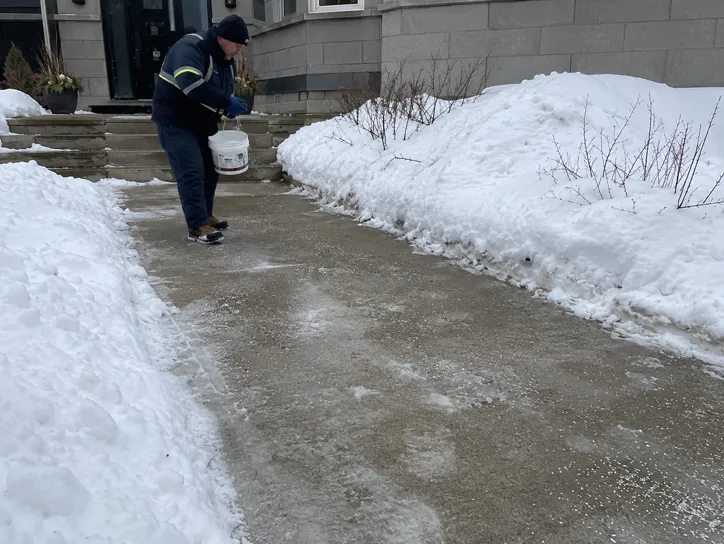
Winter routes fill early - free written quotes within one business day
Pre-treat with brine Flash freeze response Grit for instant traction Product matched to temperature

Freezing Rain and Ice Storm Response Across Ottawa

Snow Removals Ottawa – Freezing rain glazes every surface at the same moment, so there is no safe route from the car to the door and no dry patch to stand on while you work. Ice storm response is a product and timing problem far more than it is a plowing problem.

Free written quotes
24/7 storm monitoring
Serving all of Ottawa
Time-stamped service logs

Get your free snow removal quote

Tell us about the property and we will reply with a clear written price.

What can we help with?

So the right crew reviews your project.

No obligation. We reply within one business day.

-12 C Where rock salt stops working well
33% Projected rise in winter freeze events
2.5 cm City trigger on downtown sidewalks
$150-260 Typical salting and ice control visit

What an Ottawa ice storm and freezing rain response covers

Brine on the surface before the rain arrives

A liquid brine application laid down ahead of a forecast freezing rain event puts salt in solution on dry pavement, so the first droplets land in it instead of bonding to it. Preventing the bond takes a fraction of the product and time that breaking one does afterwards, and it is the difference between a treated walk and a walk with a sheet welded to it.

De-icer chosen for the temperature, not out of habit

Sodium chloride is the workhorse, but its performance falls away as pavement temperature drops toward roughly minus twelve, and below that it largely sits there doing nothing. Calcium chloride keeps reacting colder and draws moisture to itself to start the reaction. We select by pavement temperature and surface type, and the product used is recorded on the visit.

Grit for traction where nothing will melt in time

Some situations need footing immediately: a glazed slope, a ramp, a set of steps, a loading area in a deep freeze. Grit and sand melt nothing at all, they simply give a boot and a tire something to bite into. It is a bridging measure applied where the chemistry cannot act fast enough, not a substitute for de-icing the surface properly.

Every walking surface treated, not only the driving surfaces

Freezing rain does not pick targets. The driveway, the walk, the steps, the landing, the ramp, the threshold and the strip of lot people cut across all glaze within the same hour. Treating the drive and leaving the path to the door is the version of this job that produces a fall, and it is the version an insurer will ask about.

Flash freeze and refreeze passes after a thaw

The same glaze appears with no storm at all when a daytime thaw runs meltwater across a driveway and the temperature drops back through zero at dusk. That water refreezes as a clear sheet on the coldest surfaces, usually the shaded walk and the low end of the drive. Refreeze passes are part of the ice control program, not an extra call.

Ottawa ice trend

Why ice control in Ottawa is growing faster than plowing

City of Ottawa climate projections for the 2050s show winter freeze events rising by about a third, with winter temperatures hovering near zero far more often than they do now. Read operationally, that means more freezing rain, more meltwater running and then refreezing, more flash freeze at dusk, and more freeze-thaw damage to concrete, interlock and asphalt. It does not mean an easier winter. A degree either side of zero is the hardest condition this trade deals with, because it produces liquid water sitting on cold surfaces, which is precisely the recipe for a glaze. Plowing has a clear trigger and a clear finish. Ice control has neither, which is why it needs a monitored program with pre-treatment, product selection and return passes, rather than a phone call placed after somebody has already gone down on the walk.
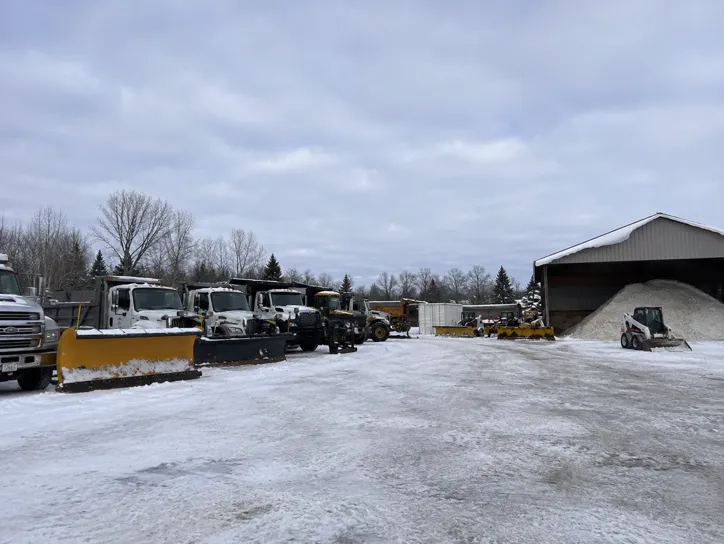
Salting and ice control in Ottawa

Ice storm hazards on an Ottawa property beyond the pavement

Weight on trees and lines

Accumulating glaze loads branches and overhead lines until they come down, often straight across a driveway. We work around what has fallen and stay clear of anything near a downed line.

Load on eaves and overhangs

Freezing rain adds mass to whatever is already on the roof and seals the surface, so a snowpack that had been shedding stops shedding and the eave carries the weight instead.

No safe path anywhere at once

Unlike snow, an ice event coats every surface simultaneously, so there is no cleared patch to stage from and no safe route at all between the vehicle and the door.

Timing

Pre-treating an Ottawa property beats chasing the ice afterwards

The whole game in a freezing rain event is whether the ice manages to bond to the surface. Brine applied beforehand keeps a salt film on the pavement, so the first freezing drizzle dilutes into it and never grips. Once a bond has formed you are melting down through it from the top with far more product, far more time, and a window in which people are already walking on glass. That gap is why we watch Environment and Climate Change Canada freezing rain warnings and dispatch on the forecast rather than on the first phone call. For a commercial occupier it matters legally too, because the duty of reasonable care under the Occupiers’ Liability Act is judged on what was done and when, and an injured person has 60 days to serve written notice. A time-stamped pre-treatment record answers that far better than a memory does.

Snow removal across Ottawa
Our Process

How we run an Ottawa freezing rain and ice storm response

1

Watch the warning, not the window

Environment and Climate Change Canada freezing rain warnings and pavement temperature drive the call, so treatment is scheduled before the event rather than after it.

2

Brine the surfaces while they are dry

Liquid pre-treatment goes down on driveways, walks, steps and entrances so the first ice has nothing clean to bond itself to.

3

De-ice and grit through the event

Product is matched to pavement temperature, with grit applied on slopes, ramps and steps where traction is needed in the moment.

4

Return for the refreeze

Meltwater refreezes as temperatures fall at dusk, so a return pass covers the shaded walk and the low end of the driveway where it collects.

Ice control services related to ice storm response in Ottawa

Talk to the crew about this property

Tell us which surfaces glaze first at your property and we will build the pre-treatment schedule around them.

Call (343) 326-3526

Freezing rain and ice storm response in Ottawa – FAQs

Why is freezing rain harder to deal with than a heavy snowfall?

Because there is nothing to remove and nowhere safe to stand. Snow can be pushed, blown or stacked, and the cleared strip gives a crew a working surface. Freezing rain coats the driveway, the walk, the steps and the road within the same hour, so there is no safe path between the car and the door and no dry ground to work from.

Which de-icer do you use when the pavement gets really cold?

Sodium chloride does most of the work in normal conditions, but its performance falls away as pavement temperature drops toward roughly minus twelve, and it becomes close to useless below that. Calcium chloride keeps reacting at lower temperatures and pulls moisture to itself to get going. We select by pavement temperature and surface, and the product used is recorded on the visit.

What is a flash freeze and why does it catch people out?

A flash freeze is a rapid drop back through zero after a thaw or a rain event, with no storm involved at all. Standing meltwater on the driveway and walk turns into a clear sheet within minutes, usually right at dusk. There is no snow to warn anybody it happened, which is why flash freeze mornings produce falls on surfaces that looked perfectly clear the night before.

Can you treat before the freezing rain starts rather than after?

That is the preferred approach and it is what the program is built around. A brine application on dry pavement ahead of the event stops ice bonding to the surface, which takes a fraction of the product and time that breaking an established bond does. It relies on forecast lead time, so monitored properties get pre-treated and one-off callers generally do not.

Do you use sand or grit, and when does that make sense?

Yes, on slopes, ramps, steps and any surface where somebody needs footing immediately and the chemistry will not act quickly enough. Grit does not melt ice, it gives boots and tires something to bite into, so it is a bridge rather than a fix. In deep cold, when de-icers slow right down, it is often the only thing that helps in the moment.

Set up ice storm response for your Ottawa property

Pre-treatment before the event, the right product for the temperature, and a return pass for the refreeze.

Back to top