Winter routes fill early - free written quotes within one business day
Cleared before opening Tenant frontage mapped Freezing rain response Time-stamped logs

Retail Plaza and Storefront Snow Removal in Ottawa

Snow Removals Ottawa – On a retail plaza the entire liability sits in one short walk: car door to store door. We clear that path before opening rather than after, define which tenant frontage belongs to whom in writing, and treat drive aisles and walkways with different products.

Free written quotes
24/7 storm monitoring
Serving all of Ottawa
Time-stamped service logs

Get your free snow removal quote

Tell us about the property and we will reply with a clear written price.

What can we help with?

So the right crew reviews your project.

No obligation. We reply within one business day.

2.5 cm City trigger on downtown sidewalks
33% Projected rise in winter freeze events
60 days Notice window after a customer falls
52 days Snow events your storefronts trade through

What retail plaza snow removal in Ottawa has to get right

The path from the car to the door, cleared first

A customer parks, steps out into the stall, crosses the drive aisle, steps up the curb and walks the sidewalk to the door. That is perhaps twenty metres, and it is where essentially every plaza slip-and-fall happens. It crosses three different surfaces that need three different treatments, so clearing the lot beautifully while leaving the curb cut glazed defeats the entire exercise.

Cleared before opening, not while customers are arriving

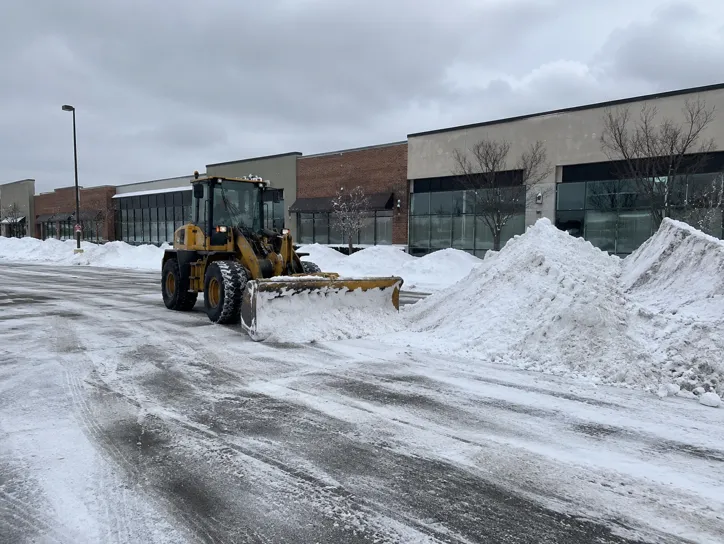
A plaza cleared at ten in the morning has already had hours of foot traffic compacting snow into the walkway, and a machine working around parked cars and pedestrians is slower and less thorough than one working an empty site. Our retail routes run overnight and through the storm so the walk and the aisles are usable when the first tenant unlocks the door.

Tenant frontages and who owns which strip of sidewalk

Most plaza disputes are about two metres of sidewalk nobody claimed. The lease may put the frontage on the tenant, the common area on the landlord, and the curb between them on nobody at all. We map the sidewalk in front of every unit before the season and put each strip into the written scope, so no length of walkway survives on the assumption that the other party is handling it.

Entrance aprons, tracked-in meltwater and the first metres inside

The floor immediately inside a retail door is the second most common fall location on a plaza, because everyone arrives carrying snow on their footwear. Aggressive de-icing outside without matting inside simply relocates the hazard across the threshold. We treat entrance aprons to cut down what gets carried in, and we tell you where matting and interior attention are needed instead of pretending the job stops at the door.

Loading zones, waste bins and back-of-house access

Deliveries and waste collection do not stop for a storm, and the back of a plaza is where snow gets pushed by default. A bin enclosure buried behind a bank means overflowing waste at the front of the property within a week, and a blocked loading door means refused deliveries. Loading areas, bin pads and rear doors are in the route with their own clearing width, not treated as leftover space.

Freezing rain response, which empties a plaza faster than snow

Twenty centimetres of snow slows a plaza down. A few millimetres of freezing rain empties it, because customers who can see ice stay home and the ones who come anyway are the ones who fall. City of Ottawa projections point to about a third more winter freeze events by the 2050s, which means more freezing rain and more flash freeze, so ice response has to be a contract term rather than a favour.

Storefront liability

Slip-and-fall exposure on an Ottawa retail plaza walkway

The Occupiers’ Liability Act asks whether the occupier took reasonable care that people on the premises would be reasonably safe. On a plaza those people are customers who did not choose your surface, arrived in whatever footwear they own, and were looking at storefronts rather than at the ground. The exposure is concentrated into a walk of roughly twenty metres. Then the 60-day written notice rule sets the timetable: a person injured on that walkway can serve written notice up to 60 days later, naming a date, a time and a location. By then the storm is long gone, the staff who worked that shift may be gone too, and the only thing that can speak to conditions at that hour is a time-stamped log showing when the walk was cleared and what was applied. That is why documentation is a plaza contract term, not an administrative extra.
Commercial snow removal in Ottawa

Retail plaza snow risks that shut Ottawa storefronts down

Freezing rain over a cleared walk

A glaze layer is harder to see and harder to treat than fresh snow, and it takes traffic away from every tenant in the plaza on the same morning.

The curb cut between lot and walk

The step from asphalt up to sidewalk is the one surface a plow cannot finish and a shovel crew is tempted to skip. It is also where people are mid-stride.

Waste and delivery access buried

Snow pushed to the back by default blocks bin pads and loading doors, and the consequences show up at the front of the property within days.

Ice control

Salting plaza drive aisles and walkways with different products in Ottawa

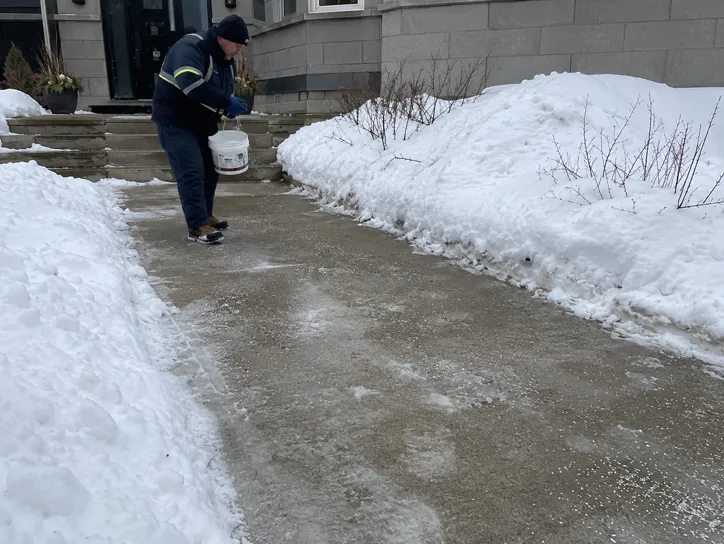
Drive aisles and pedestrian walkways are not the same job. Aisles carry braking and turning vehicles that polish residual snow into a glaze, so they take a coarser rock salt spread at a rate suited to traffic. Walkways carry people at walking speed on a surface pressed right against your tenants’ entrances, where over-application tracks into stores, damages flooring and stains carpet. Concrete walkways also react badly to heavy chloride loading over repeated freeze-thaw cycles, so the walk gets a finer application and, in deep cold where sodium chloride stops reacting, calcium chloride or grit for immediate traction instead. February is Ottawa’s heaviest snowfall month at 47 cm against January’s 39 cm, and with roughly 115 days a year carrying snow on the ground, a plaza gets treated dozens of times in a season. Product choice compounds over that many applications.

Snow removal across Ottawa
Our Process

Getting an Ottawa retail plaza ready before the first storm

1

Walk the customer path with the landlord

We trace the route from stall to storefront along every elevation and note curb cuts, low points, downspout discharge and the shaded strips that ice first.

2

Write the frontage map into the scope

Every unit's sidewalk strip, the common walkway, the loading area and the bin pads are assigned in writing so no length of surface is left unclaimed.

3

Overnight clearing and pre-treatment

Routes run ahead of your earliest opening, with pre-treatment before forecast freezing rain so a glaze does not bond to a walk you just cleared.

4

Log every visit and every application

Times, surfaces and products are recorded per visit, so a claim arriving weeks later meets a record instead of a recollection.

Retail, plaza and storefront snow services in Ottawa

Talk to the crew about this property

Give us the unit count, the frontage layout and your earliest opening time, and we will build the route backwards from it.

Call (343) 326-3526

Retail plaza snow removal in Ottawa – FAQs

Who clears the sidewalk in front of each unit, the landlord or the tenant?

Whatever the lease says, and that is the problem: leases often cover the common area and the unit but leave the frontage strip ambiguous. We map every unit's sidewalk before the season and put each strip into the written scope, so the walk is either ours or explicitly somebody else's. An unclaimed two metres of sidewalk is where a plaza claim usually starts.

How early do you clear a plaza before it opens?

We work backwards from your earliest tenant. If a coffee unit opens at six, the walkway, curb cuts and front drive aisles are finished before that, not after. Clearing an empty site is also faster and more thorough than working around parked cars and customers on foot, so the overnight pass produces a noticeably better result on the same equipment hours.

How do you handle freezing rain on a retail property?

With pre-treatment ahead of the forecast where the surface allows it, then repeated application through the event. Freezing rain empties a plaza faster than heavy snow does, because a glaze is close to invisible and the customers who arrive anyway are the ones who fall. With projections pointing to about a third more winter freeze events, this belongs in the contract as a defined response.

Can salt damage our concrete walkways and store flooring?

Over-application can, which is why walkways and drive aisles get different products at different rates. Heavy chloride loading on concrete through repeated freeze-thaw cycles causes surface scaling, and salt tracked indoors damages flooring and stains carpet. A finer walkway application, grit where traction is needed immediately, and properly treated entrance aprons reduce both problems without ever leaving the walk untreated.

Do you clear the loading area and the waste bin enclosure?

Yes, with their own clearing width written into the scope. The back of a plaza is where snow gets pushed by default, and a buried bin pad or a blocked loading door produces overflowing waste and refused deliveries inside a week. Rear access is part of the route rather than the space left over once the front of the property is finished.

Keep your Ottawa plaza open all winter

Free site walk-through, a written frontage map and clearing scheduled around your earliest opening time.

Back to top